
If you're planning a garden project in Surrey, the first question is usually "how much will it cost?" The honest answer is: it depends — but not in the vague, evasive way that phrase normally gets used. There are real, documented cost ranges for most garden work, and the variables that push prices up or down are entirely predictable once you understand where the money goes.
This article breaks that down transparently. Every cost figure cited comes from UK trade platforms (Checkatrade, MyJobQuote, Rated People), and where we draw on our own experience, we say so. Landscaping costs in Surrey and the South East typically run above national averages — a point worth remembering when comparing quotes against figures you find online.
Where the money actually goes
A garden project has four main cost components: materials, labour, design, and contingency. The balance between them shifts depending on the project, but as a rough guide, materials and labour each account for around 35–45% of the total, with design fees at 10–20% and contingency absorbing the remainder.
Materials are the most variable element. The difference between a 20m² patio in concrete slabs (£1,400–£2,000 installed) and the same area in porcelain (£2,000–£3,600 installed) is significant — but so is the difference in how long they last. We'll come back to that.
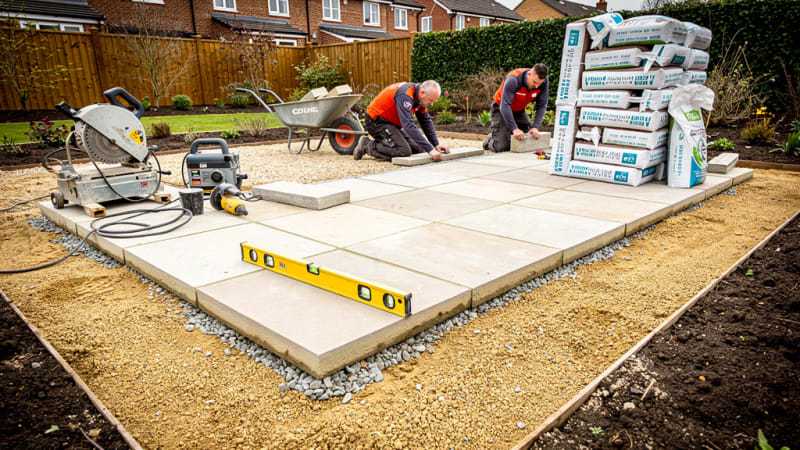
Labour reflects skill and time. A professional team will lay a 20m² patio in two to four working days. That time covers excavation, sub-base preparation, laying, cutting, jointing, and cleanup. The preparation stages — which are invisible in the finished result — are where quality is built or compromised. A properly compacted sub-base prevents sinking and unevenness for decades. A rushed one shows its problems within a year or two.
Design fees typically range from £500–£1,500 for plans, or 10–20% of the total project budget for larger schemes. This is often the line item people question first — and it's the one that arguably delivers the most value per pound spent. A professional design ensures that a £15,000 build delivers a £15,000 result rather than a £15,000 collection of features that don't quite work together. From our experience, design also catches expensive mistakes before they happen: drainage problems, access issues, planting that won't suit the aspect or soil.
Contingency — and this is the line most quotes leave out — should be 10–15% of the total. Gardens involve digging, and digging involves surprises: unexpected drainage runs, root systems, soil conditions, buried rubble. A responsible quote accounts for this. An irresponsibly low quote doesn't.
What projects actually cost
These ranges are drawn from multiple UK trade platforms and reflect 2025–2026 pricing, with the caveat that Surrey prices sit toward the upper end:
A full garden redesign for a small space runs £2,750–£5,000 for basic soft and hard landscaping. A medium project — professional design and build with quality materials — typically falls between £5,000 and £15,000. Comprehensive redesigns with multiple features (patios, planting, lighting, water features, garden buildings) range from £15,000 to £50,000 and beyond.
For specific elements: a 20m² patio in Indian sandstone costs £1,600–£2,800 installed. Porcelain runs £2,000–£3,600 for the same area. Fencing at 20 metres costs £1,400–£2,500 depending on panel type and access. Composite decking for 15m² runs £1,800–£3,750.
These are honest ranges. If a quote comes in dramatically below them, the question isn't whether you've found a bargain — it's what's been left out.
The cheapest quote problem
"Get three quotes and pick the middle one" is common advice. It's also incomplete. Three quotes are only comparable if they're quoting the same specification — the same materials, the same preparation, the same finish. In practice, the cheapest quote often achieves its price by specifying thinner sub-base, lower-grade materials, or fewer preparation stages. You're not comparing like with like.
A more useful approach: ask each contractor to quote against the same specification. Ask what sub-base depth they're proposing. Ask what happens if they hit unexpected ground conditions. Ask whether their price includes waste removal and site clearance. The answers reveal more than the bottom line.
From fifty years of our family business working across Surrey, we've seen the results of quotes that were won on price. Patios that sink within two years because the sub-base was 50mm instead of the standard 150mm. Fencing that fails in the first storm because posts weren't set deep enough. These aren't theoretical risks — they're the projects we're often called in to fix.
Material choice is a long-term financial decision
This is where "cost" and "value" diverge most sharply.
Porcelain paving, with water absorption below 0.5% (the standard classification threshold), is effectively frost-proof and stain-resistant. Expected lifespan: 30–50+ years with virtually no maintenance beyond occasional cleaning. Indian sandstone is more affordable upfront but porous — it requires sealing every one to five years and faces accelerated degradation from moisture and frost in our climate. Expected lifespan: 30–50 years, but with significantly higher ongoing costs.
Over 30 years, the lifecycle cost comparison is striking. A 20m² porcelain patio runs an estimated £2,200–£5,100 total (install plus maintenance). The same area in Indian sandstone: £4,400–£7,300, once you factor in regular sealing, cleaning, and potential partial replacement. These are synthesised estimates from multiple trade sources rather than a single authoritative study — but they consistently point the same direction.
The same principle applies to decking. Softwood timber costs roughly half of composite to install but requires annual sanding, staining, and sealing. NeoTimber's published 25-year cost comparison calculated maintenance at £2,300+ for softwood versus £414 for composite. The cheaper option to buy is the more expensive option to own.
The practical takeaway: investing in a smaller area of better material consistently outperforms spreading budget across a larger area of cheaper material. A well-laid 15m² porcelain patio will outlast and look better than a 25m² concrete slab patio within a decade.
What about DIY?
There's a financial saving from doing it yourself — but it's smaller than most people expect. A 20m² Indian sandstone patio costs roughly £900–£1,500 in materials for DIY. Factor in tool hire (plate compactor, skip, mixer: £400–£700), materials waste (10–15% extra for cutting errors), and the realistic total lands at £1,390–£2,425. Professional installation for the same specification: £1,600–£2,400.
The financial gap narrows to perhaps £200–£500 once hidden costs are included. The quality gap doesn't narrow at all. The critical failure points for DIY hard landscaping — poor sub-base compaction, incorrect drainage falls, inadequate jointing — are the kind of mistakes that are invisible on completion day and expensive to fix two years later.
For soft landscaping — planting, lawn care, painting fences, mulching beds — DIY makes excellent sense. The materials are forgiving and mistakes are recoverable. For anything involving drainage, structural elements, or electrical work, the economics of professional installation are stronger than they first appear.
The honest summary
Garden projects cost what they cost because good materials, skilled labour, and proper preparation aren't optional — they're the difference between a garden that lasts and one that needs redoing in five years. The evidence consistently shows that maintenance, material longevity, and workmanship quality matter more to long-term value than the initial price tag.
If you're planning a project in Surrey, budget realistically, ask detailed questions of anyone you're getting quotes from, and think in terms of what you'll be paying — and enjoying — in year ten, not just on completion day.
