South East England is warming faster than almost any other region in the UK. That's not a projection — it's a measurement. Met Office data shows spring temperatures in the south-east have risen 2.1°C above 1970 levels, the joint highest increase of any English region. Days exceeding 30°C have more than tripled compared to the 1961–1990 baseline. And in July 2022, RHS Wisley — barely fifteen miles from our base in Woking — recorded 39.3°C.
For Surrey homeowners, this isn't abstract climate science. It's changing what grows, what drains, what survives, and what thrives in your garden right now.
What the data actually shows
The headline pattern for the south-east is stark: hotter summers, wetter winters, and both extremes intensifying. The Met Office's State of the UK Climate report (Kendon et al., 2025, published in the International Journal of Climatology) confirms that the most recent decade is 1.24°C warmer than the 1961–1990 average nationally, with the south-east experiencing some of the sharpest increases.
Rainfall is redistributing. UK winters over the past decade are 16% wetter than the 1961–1990 baseline, with the winter of 2023–24 the wettest on record for England and Wales in a series beginning 1767 (Met Office). Attribution analysis found that rainfall was 20% more intense due to climate change and 10 times more likely to occur. Meanwhile, the 2022 drought delivered just 46% of average summer rainfall to the Thames region.
UKCP18 projections suggest this pattern will amplify: summer rainfall could decrease by up to 47%, while winter precipitation could increase by up to 35% by the 2070s under high emissions scenarios. Even as average summer rainfall falls, extreme hourly rainfall events may intensify by up to 112% — cloudbursts onto baked ground rather than steady, useful rain.
The growing season has extended too. Using Central England Temperature data, the average thermal growing season has lengthened by approximately 29 days compared to the 1961–1990 average (Met Office HadUK-Grid). Six of the ten longest growing seasons have occurred in the last 30 years.
What Joe sees on the ground
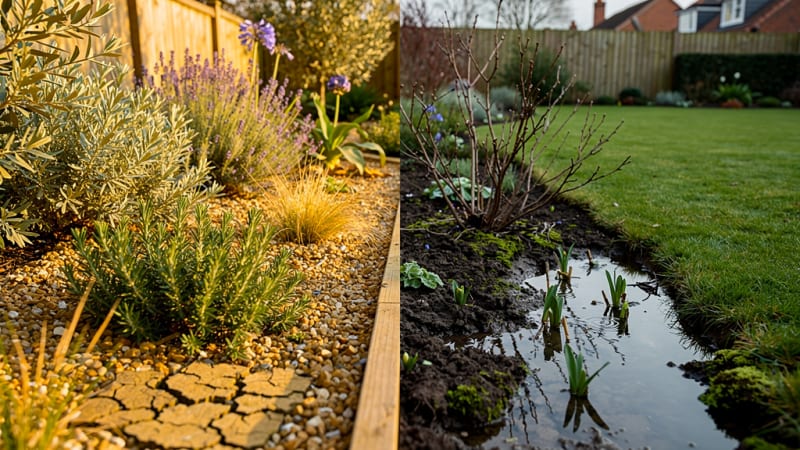
The data confirms what we've observed across thousands of Surrey gardens over 50 years. [Practitioner experience] Planting windows have shifted. Lawns that needed little supplemental watering a generation ago now brown through July and August without intervention. Plants we'd never have recommended for Surrey 20 years ago — Mediterranean evergreens, ornamental grasses from warmer climates — are now reliable choices. And drainage that was adequate when a garden was built in the 1990s is increasingly overwhelmed by the intensity of winter rainfall.
This isn't about doom. It's about designing honestly for the conditions that exist now, not the ones we remember.
What it means for your garden
Drainage needs rethinking
Since October 2008, planning permission has been required for laying impermeable hard surfaces exceeding 5 m² in front gardens unless permeable surfacing is used or rainwater drains naturally within the garden (UK Permitted Development Order). That regulation exists because paved gardens contribute an estimated £270 million annually to flood costs.
Surrey County Council's SuDS design guidance now mandates that the first 5mm of rainfall must not generate any runoff from a site. Peer-reviewed studies show rain gardens capture over 86% of stormwater runoff (Villanova University) and remove roughly 80% of suspended solids. The RHS recommends sizing rain gardens at approximately 20% of the roof area they drain.
For Woking-area gardens on free-draining Bagshot sands, simple soakaways work well. On London Clay — towards Byfleet or Weybridge — lined rain gardens with overflow connections are needed. Either way, water harvesting should be standard in every garden design.
Plant selection is shifting
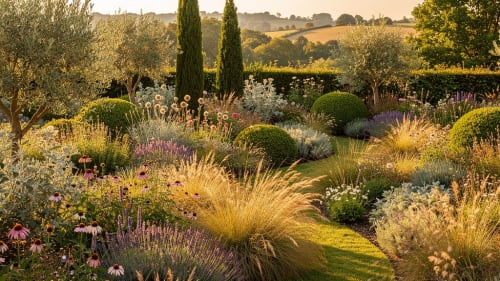
The RHS's landmark 2017 report predicted that south-east England gardens would shift toward Mediterranean-climate planting. Much of that is already underway.
Peer-reviewed research confirms that UK plants now flower almost one month earlier on average compared to before 1986 (Büntgen et al., 2022, Proceedings of the Royal Society B). Hardiness zones across the south-east have shifted roughly half to one full zone warmer, meaning species rated RHS H3 — half-hardy, tolerating down to -5°C — can now be grown confidently in sheltered positions in most years.
Critically, a University of Reading study funded by the RHS tested four Mediterranean species — lavender, lamb's ears, cistus, and sage — for waterlogging tolerance. All four survived 17 days of flooding in winter. These aren't just drought plants. They handle Surrey's wet winters too.
The RHS Plants for Bugs project at Wisley found that a mixed planting approach is optimal: native plants support the widest invertebrate range, but near-natives perform within 10% and exotics extend the flowering season. The conclusion — diversity of plant origin is a strength, not a weakness — directly supports using Mediterranean species alongside native framework planting.
Conversely, some traditional choices are under pressure. The RHS explicitly states that beech (Fagus sylvatica) is "ill adapted to dry conditions and therefore not a wise choice in southern and eastern Britain." Box faces the dual assault of blight and box tree moth.
Hard surfaces create measurable heat problems
A University of Surrey study specifically modelling Guildford (Tiwari et al., 2020, Environmental Pollution) found that trees are the most effective green infrastructure for temperature reduction. A Manchester study measured concrete in full sun reaching 19–23°C above air temperature on hot days, while grass measured 0–3°C below — a differential of roughly 24°C between hard and vegetated surfaces.
A mature deciduous tree on the south or west side of a garden intercepts up to 90% of incoming solar radiation while allowing winter light through (Forest Research). Multi-layered planting — tree canopy, shrub layer, ground cover — provides 2–5°C cooling compared to open paving.
Soil is the foundation of resilience
Across all soil types, organic matter is the single most important factor in a garden's ability to handle climate volatility. For every 1% increase in soil organic matter, the top 30cm of soil can hold an additional 16,500 gallons of water per acre (Environment Agency). On Woking's sandy Bagshot soils — naturally acidic, nutrient-poor, and free-draining — building organic matter through heavy mulching and regular compost application is essential. On clay, organic matter moderates the shrink-swell cycle that causes subsidence damage costing over £400 million per year nationally (British Geological Survey; Association of British Insurers).
Designing for volatility, not for averages
The overarching pattern in the evidence is not simply "warming." It's increasing volatility — hotter extremes and cooler snaps, wetter winters and drier summers, drought stress followed by waterlogging.
Three principles run through the research. First, soil health is the foundation: whatever your soil type, organic matter determines your garden's capacity to buffer both drought and deluge. Second, diversity is insurance: mixed-origin planting and multi-layered structures outperform any monoculture for resilience. Third, every garden feature can serve multiple purposes: a rain garden manages drainage, cools the microclimate, supports pollinators, and sequesters carbon; a hedge stores 40 tonnes more carbon per hectare than grassland (Biffi et al., 2025, Agriculture, Ecosystems & Environment) while providing habitat, screening, and wind protection.
We've been designing and building gardens across Surrey for over 50 years. The conditions are changing — measurably, significantly, and in ways that affect real decisions about materials, planting, and drainage. The good news is that the evidence is clear on what works.
Adapting to these conditions is something we build into every garden landscaping project we take on. Ongoing adaptation is also why regular garden maintenance matters more than ever.
For immediate practical steps, see our spring garden prep guide for Surrey.
Want a garden that’s ready for what’s coming? Get a free quote.