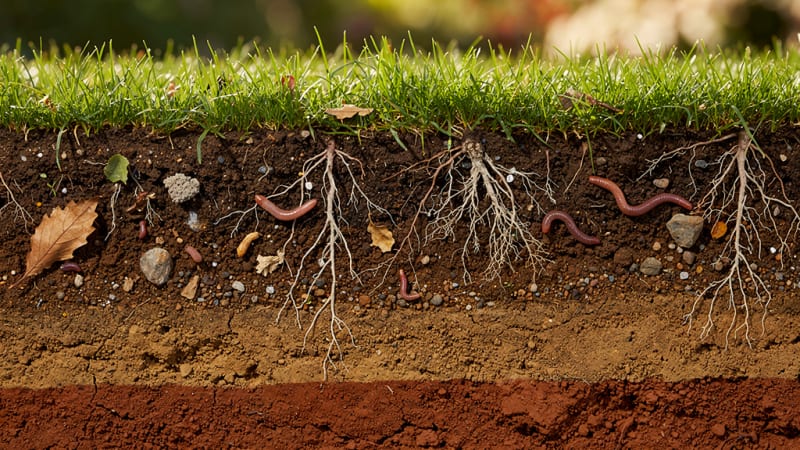
A single handful of healthy garden soil contains more living organisms than there are people on the planet. Bacteria, fungi, protozoa, nematodes, mites, springtails, earthworms — an entire ecosystem operating beneath your feet, largely invisible and almost entirely ignored by conventional gardening advice.
This isn't trivia. What's happening in your soil determines almost everything that happens above it: how well your plants grow, how effectively your garden handles drought and flood, how much maintenance you'll need to do, and how resilient the whole system is to stress. Understanding even the basics of soil biology changes how you think about your garden — and, in practical terms, how you should treat it.
The Underground Network
The most remarkable feature of healthy soil is the mycorrhizal network — a web of fungal threads that connects plant roots to each other and to nutrients they couldn't reach alone. The science here is well established and still expanding. Research published over the past three decades has demonstrated that over 90% of plant species form mycorrhizal associations, and that these relationships are genuinely mutualistic: the plant provides the fungus with carbon (from photosynthesis), and the fungus provides the plant with phosphorus, nitrogen, water, and trace minerals from a far larger soil volume than the roots could access independently.
The practical implications are significant. Mycorrhizal networks effectively extend a plant's root system many times over. A plant with a healthy fungal partnership can access water and nutrients from soil well beyond its own root zone. In drought conditions — increasingly relevant in Surrey summers — this can be the difference between a plant that copes and one that fails.
These networks also facilitate communication and resource sharing between plants. Research from the University of British Columbia and subsequent studies have shown that trees connected by mycorrhizal networks can transfer carbon and nutrients between individuals, with established trees effectively subsidising younger ones. Whether this constitutes intentional cooperation or simple chemical gradient flow is debated, but the mechanism itself is well documented.
Why This Matters for Your Garden
The first practical takeaway is straightforward: protect what's already there.
Healthy soil biology builds itself over time. Fungal networks establish, bacterial communities develop, earthworm populations grow, organic matter accumulates. This biological infrastructure is what makes soil fertile, well-structured, and resilient. It takes years to build and minutes to damage.
The most common ways gardeners inadvertently damage their soil biology:
Unnecessary digging. Every time soil is turned over, fungal networks are physically severed, soil structure is disrupted, and the layered communities that have developed are homogenised. There are situations where cultivation is necessary — breaking up severe compaction, incorporating amendments into degraded soil — but routine digging of established beds destroys more than it creates. The no-dig approach, championed by practitioners like Charles Dowding and supported by a growing body of research, works precisely because it allows soil biology to develop undisturbed.
Chemical overuse. Broad-spectrum fungicides don't distinguish between pathogenic fungi and beneficial mycorrhizal species. Excessive synthetic fertiliser can suppress mycorrhizal colonisation — when nutrients are artificially abundant at the root surface, plants invest less in fungal partnerships. This creates dependency: the more you feed, the more you need to feed, because the natural nutrient-cycling systems have been undermined.
Compaction. Soil biology needs air. Specifically, it needs the pore spaces between soil particles where water, air, and organisms move. Compaction — from foot traffic, machinery, or working wet soil — collapses these pores. In Surrey's clay soils, which are already prone to compaction, this is a particular concern. Heavy clay worked when wet can set almost like concrete, and the biological recovery is slow.
Paving over everything. This is obvious but worth stating: every square metre of impermeable surface eliminates the soil ecosystem beneath it. Hard landscaping is a necessary part of most gardens, but the trend toward maximising paved area at the expense of planted ground has consequences beyond aesthetics. Sealed soil doesn't absorb rainfall, doesn't support biology, doesn't sequester carbon, and doesn't contribute to the garden as a living system.
The Carbon Story
Soil is the largest terrestrial carbon store on the planet — containing more carbon than the atmosphere and all plant life combined. This is well-established science from bodies including the IPCC and the UK's Centre for Ecology & Hydrology.
At garden scale, the principle still applies. Healthy, biologically active soil with good organic matter content stores carbon. Degraded, compacted, or sealed soil doesn't. Every garden that maintains healthy soil is, in a small way, contributing to carbon storage rather than carbon release.
This isn't an argument for turning every patio into a flower bed. It's context for understanding that the ground beneath your garden isn't inert — it's an active system performing functions that benefit both your plants and, cumulatively, the wider environment.
What You Can Do
The encouraging news is that soil biology is resilient given the right conditions. You don't need to become a soil scientist to support it:
Mulch. A layer of organic mulch — composted bark, garden compost, leaf mould — feeds soil organisms, suppresses weeds, retains moisture, and protects the surface from compaction. It's the single most effective thing most gardeners can do for their soil, and it's simple.
Reduce disturbance. If your soil isn't compacted and your beds are established, stop digging them. Add compost and mulch to the surface and let the biology incorporate it. Earthworms are better at this than you are.
Tolerate some mess. Leaf litter, fallen organic material, and undisturbed corners provide habitat and food for soil organisms. The immaculate, swept-clean garden is a biological desert compared to one where some natural processes are allowed to operate.
Protect soil during construction. If you're having garden work done, soil protection should be part of the plan. Topsoil that's been driven over by machinery, stored improperly, or mixed with subsoil loses much of its biological value. This is something we're particularly attentive to during landscaping projects — the soil you start with is an asset worth preserving.
The Living Foundation
We talk a lot about garden design — about layouts, materials, planting schemes, and visual impact. All of that matters. But it all sits on top of a biological system that most people never see and rarely think about. Understanding that system, even at a basic level, changes the decisions you make. It shifts the focus from what a garden looks like to how it functions — and gardens that function well tend to look after themselves far better than those that don't.
The soil beneath your lawn is not dirt. It's infrastructure. Treat it accordingly.
Understanding your soil is the foundation of good garden maintenance and aftercare. It also matters when planning a new garden from scratch — soil type determines what works.
Want expert advice on your garden’s soil? Talk to us.