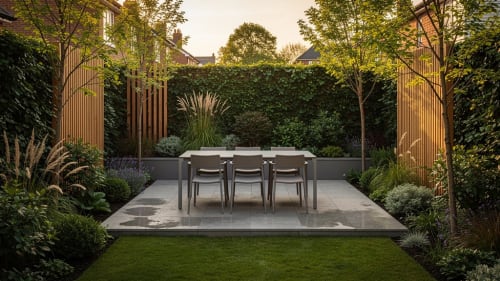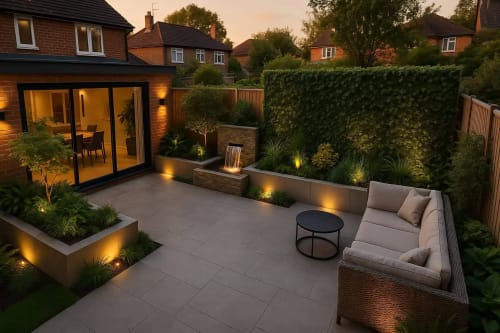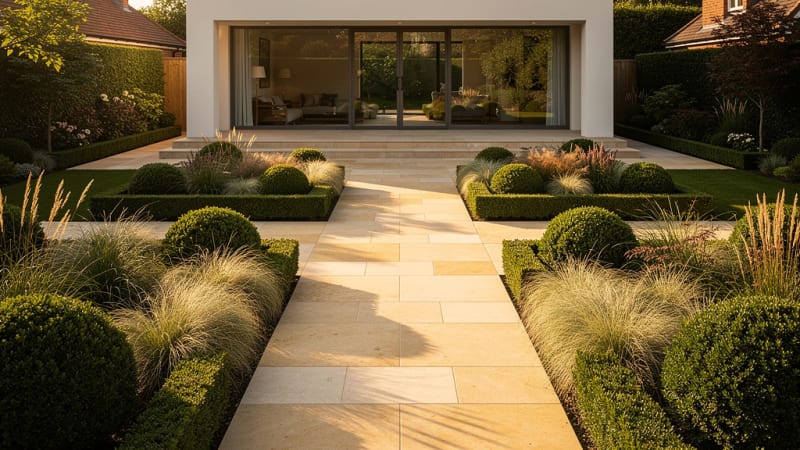
"Contemporary" is one of the most requested and least understood words in garden design. Clients use it to mean modern, minimal, clean-lined — but also, sometimes, "not what my parents had." Designers use it to mean current thinking applied to a specific space. The garden industry uses it to sell grey composite decking and architectural planters.
The result is a lot of confusion, and a lot of gardens that were contemporary for about eighteen months before they started looking like everything else on the street.
There's a better way to think about it.
What Contemporary Actually Means
Contemporary garden design, in its proper sense, is about current principles applied with clarity. It tends to favour clean geometry, considered material palettes, intentional planting, and a strong relationship between indoor and outdoor space. It's characterised more by discipline than by any specific material or plant.
The distinction matters because it separates style from substance. A garden full of trendy materials arranged without underlying design logic isn't contemporary — it's fashionable, which is a different thing with a shorter shelf life.
Good contemporary design shares DNA with good design of any era. The fundamentals — scale, proportion, material honesty, structural integrity that doesn't depend on everything being in bloom — are established design principles, not passing preferences. What changes is how they're expressed.
Why Some Contemporary Gardens Date and Others Don't
Walk through any suburban area in Surrey and you'll see the evidence. [Practitioner observation] Gardens built five or six years ago with uniform grey paving, grey fencing, grey planters, and a single species of ornamental grass look dated now in a way their owners probably didn't anticipate. The palette was everywhere for a few years, and "everywhere" is the enemy of contemporary.
The contemporary gardens that hold up tend to share certain qualities:
Material honesty. Natural stone, good timber, and quality metalwork develop character as they age. They patina, they weather, they settle into their surroundings. Composite materials and reconstituted stone try to imitate something they're not, and the imitation degrades rather than improves over time. We see this consistently across our maintenance portfolio — a contemporary design built with honest materials looks better at year ten than at year one.
Planting depth. The minimal-planting aesthetic — three grasses and a row of box — is easy to install and easy to maintain, but it produces gardens with no seasonal interest and no ecological value. The best contemporary planting design uses a limited palette but deploys it with understanding: layers of texture, staggered flowering, winter structure, movement in wind. It looks edited, not empty.
Restraint, not emptiness. Contemporary design is often confused with minimalism, and minimalism is often confused with having very little in the garden. Genuine restraint means every element earns its place. It means choosing fewer, better things and placing them with care. An empty garden isn't minimal — it's unfinished.
Connection to context. A contemporary garden in Surrey should respond to Surrey. The local materials, the prevailing conditions, the character of the surrounding landscape — these aren't constraints on contemporary design, they're inputs to it. A garden that could be anywhere is a garden that belongs nowhere.
Contemporary Design in Smaller Spaces
Contemporary principles are arguably more valuable in small gardens than large ones. When space is limited, every decision is amplified. A poorly proportioned path or an oversized feature that might be absorbed in a larger plot becomes the dominant element in a courtyard.
The clarity that contemporary design demands — clean lines, considered proportions, intentional choices — is exactly what small spaces need. Complexity in a small garden creates visual noise. Simplicity, properly executed, creates a sense of space that the physical dimensions wouldn't suggest.
A few principles we've seen work consistently in smaller contemporary gardens across Surrey:
Fewer materials, used well. Choose two or three materials and use them throughout. The visual continuity makes the space feel larger and more considered. Mixing five different surfaces in a small area fragments the eye and shrinks the perceived space.
Vertical layers. Small gardens benefit enormously from vertical interest — climbers, raised planters, green walls, overhead structures. The eye moves up and down as well as across, and the garden gains volume without consuming floor space.
Borrowed views. If there's anything worth looking at beyond your boundary — a mature tree, a church spire, open sky — design to frame it rather than screen it. The garden extends visually beyond its physical limits. This is an established garden design technique, and it's especially valuable in tight Surrey plots where visual space matters more than square footage.
One strong focal point. A single well-chosen element — a specimen tree, a water feature, a piece of sculpture — gives a small garden a centre of gravity. Multiple competing focal points in a small space create confusion rather than interest.
Getting Contemporary Right
The risk with contemporary garden design is that it can feel cold, impersonal, or generic. That's not a failure of the style — it's a failure of application. Contemporary design done well is warm, inviting, and deeply personal. It reflects how the specific people who live there want to use their specific space.
The difference usually comes down to the design process. A contemporary garden that starts with a material catalogue — "I want this paving and this fencing" — tends to feel assembled. One that starts with questions about lifestyle, movement, light, and seasonal use tends to feel designed.
In Surrey, we have the advantage of working within a landscape that offers real character: mature trees, varied topography, established settlement patterns, and enough climatic range to support a wide planting palette. Contemporary design here doesn't need to fight its context. The best examples embrace it — using the existing qualities of site and surroundings as the starting point, then applying contemporary clarity to make the most of what's there.
That's the version of contemporary garden design that lasts. Not a style imposed from a catalogue, but a set of principles applied to a real place for real people. Design that's current without being disposable.
If you're considering a contemporary approach for your own garden, see how we work through the planning and design process. We put these principles into practice recently with a contemporary remembrance garden in Guildford — a project where modern design serves deeply personal meaning.
For more on the fundamentals that underpin any good garden design, read what makes a garden design actually work.
Ready to talk about your garden? Get a free quote.