Surrey's climate isn't what it was. That's not speculation — it's measured. Met Office data shows spring temperatures in South East England have risen 2.1°C above 1970 levels, the growing season has extended by nearly a month, and the number of days exceeding 30°C has more than trebled since the 1960s (Met Office HadUK-Grid; State of the UK Climate 2024, Kendon et al., 2025). In July 2022, RHS Wisley — just down the road from our base in Woking — recorded 39.3°C.
But the headline isn't simply "hotter." It's more volatile. Wetter winters, drier summers, and both extremes intensifying. The winter of 2023–24 was the wettest on record for England and Wales (Met Office, series from 1767), while the 2022 drought saw the Thames region receive just 46% of average summer rainfall (Barker et al., 2024, Weather). UKCP18 projections suggest summer rainfall could decrease by up to 47% while winter precipitation increases by up to 35% by the 2070s.
For Surrey homeowners investing in their gardens, this changes what "good design" means.
What "Mediterranean planting" actually means on Surrey clay
There's a popular shorthand that gardens need to go Mediterranean. The RHS's 2017 "Gardening in a Changing Climate" report — produced with the Universities of Sheffield and Reading — did project a shift toward Mediterranean-climate planting in SE England. But the phrase can mislead if it conjures images of dry gravel and lavender alone.
The reality for most Surrey gardens is more nuanced. Your soil type determines everything. The Woking area sits on Bagshot Formation sands — acid, free-draining, nutrient-poor (British Geological Survey, Guildford District Memoir). Head toward Byfleet or Weybridge and you're on London Clay, which behaves completely differently: waterlogged in winter, cracked and shrunken in summer. The BGS estimates shrink-swell damage on London Clay has cost over £3 billion in the past decade (Harrison et al., 2012, Proceedings of the Geologists' Association).
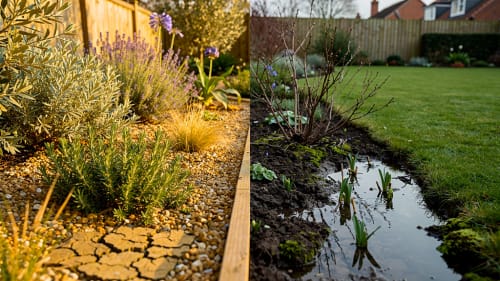
Mediterranean plants can work on both — but the critical question is whether they tolerate winter waterlogging, not just summer drought. Research funded by the RHS at the University of Reading (2005–2009) tested exactly this. Four Mediterranean species — Lavandula angustifolia, Cistus × hybridus, Salvia officinalis, and Stachys byzantina — all survived 17 days of winter flooding. That's genuinely useful evidence: these aren't just drought plants. They handle the full wet-dry cycle that Surrey now delivers.
Plants that handle what's coming
The RHS has published a definitive list of plants tolerating both seasonally wet and dry soils — the single most relevant resource for Surrey's conditions (RHS Advisory Service, December 2015, compiled at Wisley). Here are some of the strongest performers, grouped by role.
Structural trees. Hornbeam (Carpinus betulus) is native, dual-tolerant, and increasingly recommended as a replacement for beech — which the RHS now explicitly warns is "not a wise choice in southern and eastern Britain" due to drought intolerance. Field maple (Acer campestre) and sessile oak (Quercus petraea) provide native framework. For smaller gardens or warmer microclimates, strawberry tree (Arbutus unedo) and Judas tree (Cercis siliquastrum) thrive in Surrey's shifting conditions.
Shrubs. Viburnum tinus 'Eve Price', Choisya ternata, and Osmanthus × burkwoodii all tolerate both extremes. These are reliable, evergreen, and provide year-round structure without demanding constant intervention.
Perennials. Geranium 'Rozanne' is a workhorse — long-flowering and genuinely tough. Euphorbia characias subsp. wulfenii handles drought and poor soil. Verbena bonariensis self-seeds freely on most Surrey soils and extends the flowering season into autumn. Stachys byzantina 'Silver Carpet' proved the most waterlogging-tolerant Mediterranean species in the University of Reading trials.
Grasses. Stipa gigantea and Calamagrostis × acutiflora 'Overdam' provide structural interest while managing wet-dry cycling.
The broader principle, validated by the RHS Plants for Bugs project at Wisley (2009–2013), is that mixed-origin planting outperforms any single approach. Native plants support the widest invertebrate range, near-natives perform within 10%, and exotics extend flowering into late summer. Diversity is resilience.
Soil: the foundation nobody sees
Whatever you plant, soil condition determines whether it survives. The evidence here is stark: for every 1% increase in soil organic matter, the top 30cm can hold an additional 16,500 gallons of water per acre (Environment Agency, "State of the Environment: Soil," 2019). That buffer works in both directions — holding moisture through dry spells and absorbing rainfall before it runs off.
On Bagshot sands around Woking, the priority is building water retention. These soils drain fast but hold almost nothing. Heavy mulching, regular compost application, and avoiding bare soil exposure are the basics. On London Clay, organic matter improves structure and moderates the shrink-swell cycle that damages foundations and hardscaping.
Across both soil types, organic matter is under pressure nationally. UK soils have lost 40–60% of their organic carbon (Environment Agency, 2019). Every garden design we produce now treats soil preparation as infrastructure, not an afterthought.
Design that handles extremes
The temperature data has practical design consequences. A University of Surrey study modelling Guildford found that trees are the most effective green infrastructure for temperature reduction (Tiwari et al., 2020, Environmental Pollution). Separate Manchester research measured concrete in full sun reaching 19–23°C above air temperature, while grass measured 0–3°C below — a differential of roughly 24°C between hard and vegetated surfaces (Armson et al., Urban Forestry & Urban Greening).
For garden design, this translates to three priorities:
Shade as infrastructure. A mature deciduous tree on the south or west side intercepts up to 90% of incoming solar radiation in summer while allowing winter light through (Forest Research). This isn't optional aesthetics — it's functional climate management.
Water capture. Since October 2008, planning permission is required for impermeable hard surfaces over 5m² in front gardens unless runoff is managed (UK Permitted Development Order). Beyond compliance, rain gardens capture 86% of stormwater runoff (Villanova University study) and require minimal maintenance. The RHS recommends sizing them at approximately 20% of the roof area they drain.
Permeable surfaces. Where hard landscaping is needed, permeable materials handle drainage at source. Block paving runs £70–£140/m² installed in SE England versus £60–£80/m² for standard concrete — a modest premium that eliminates separate drainage infrastructure.
The honest summary
We've been building and maintaining gardens across Surrey for over 50 years, across two generations. In that time, the conditions our gardens face have measurably changed. What we plant today will experience a climate through its lifespan that is significantly different from 20 years ago — that's not opinion, it's Met Office data.
The practical response isn't dramatic. It's choosing plants with proven dual tolerance. Building organic matter. Designing shade and water management into the structure from the start. Using evidence-based resources like the RHS wet-and-dry plant list rather than guessing.
Good garden design has always meant working with your conditions rather than against them. The conditions have shifted. The design thinking needs to shift with them.