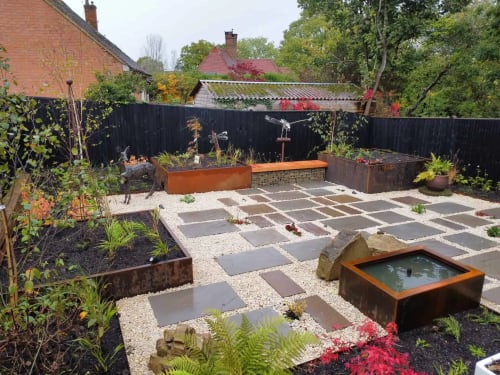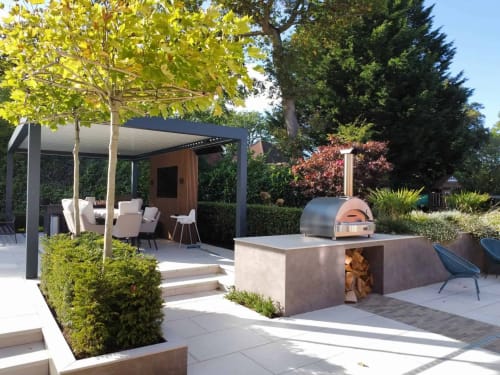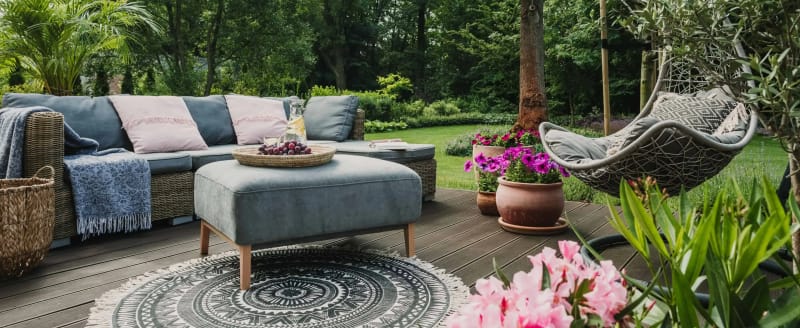
East Horsley is one of the more distinctive areas we work in across Surrey — not because it's the largest or closest to our Woking base, but because the combination of geology, landscape character, and plot sizes creates a set of garden situations that rewards careful thinking. Large plots, semi-rural settings, mature hedgerows, and soil that transitions between chalk and heavy clay within relatively short distances: these are the conditions that make garden design here different from working in a suburban town five miles down the road.
We've worked in East Horsley and the surrounding Horsley villages long enough to understand those conditions in practice. The access logistics are different here — narrower country lanes can affect material deliveries. The design register is different — gardens that back onto open farmland or woodland sit in a wider landscape that influences what looks right. And the wildlife considerations are real rather than theoretical.
The geology of the Horsleys
East and West Horsley sit on the dip slope of the North Downs — the gentler north-facing slope of the chalk ridge rather than the steeper scarp face to the south. The geology here transitions across a relatively short distance, and it changes significantly.
On the higher ground — the chalk downland of the ridge itself and the upper slopes — you get the same free-draining, alkaline soil that characterises the Downs. Good drainage, high pH, and the specific planting implications that come with both. Alkaline conditions exclude certain plants (acid-loving species need soil modification to perform well, and even then the results are often marginal) and favour others — a different palette to work with, but a coherent and often very attractive one.
Drop northward from the ridge and the geology shifts toward Gault clay and the clay-rich soils of the Weald. This is among the heavier clay in Surrey: high moisture-retention, slow-draining, and demanding in terms of foundation design and drainage management. In wet winters the difference is stark. Ground that drains freely on the chalk becomes waterlogged on the clay, and projects designed without accounting for that difference show the problem within a season or two.
The transition zone between chalk and clay produces some of the most geologically varied gardens we work in. Soil changes within a single plot are possible — particularly where historic building work, drainage ditches, or natural topography have mixed layers. We assess each site rather than making assumptions from location alone, but the geological picture gives us the right starting point.
The character of East Horsley's gardens
The Horsley villages have large plots by Surrey standards. Many properties have gardens that connect to open countryside — paddocks, woodland, or farmland on the boundary. That semi-rural context shapes what feels right in design terms.
Gardens here generally call for less hard landscaping relative to their total area and more emphasis on planting, structure, and working with the existing landscape rather than imposing a new one. A heavily paved, hard-landscaped garden in an urban setting works well. The same approach on the edge of a Surrey village, where the garden looks out over hedgerows and fields, can feel incongruous. The best gardens in the Horsleys tend to feel continuous with their surroundings rather than in contrast to them.
That doesn't mean minimal intervention. Well-designed planting in a large semi-rural plot requires as much thought as any other garden — more, in some ways, because the design has to function at a larger scale and often over longer sight lines. Structure, seasonal interest, and year-round management all matter.
Mature hedgerows are a feature of many East Horsley properties. Native species hedges — hawthorn, blackthorn, field maple, hazel — have both landscape and ecological value. Where they exist, we generally design with them rather than removing them. Where they need management, the approach depends on the species, the condition, and the role the hedge is playing in the wider design.
The roads around Sheepleas and Forest Road serve some of the larger residential plots in the area — properties with gardens that can run to half an acre or more. These commissions tend to be long-term in character: design, build, and then ongoing maintenance over years as the planting establishes and matures.
Wildlife in East Horsley gardens
East Horsley sits adjacent to several Sites of Special Scientific Interest, and the wider landscape around the Horsley villages is ecologically rich. That context is relevant to garden design in a practical way.
The area supports good populations of hedgehogs, bats, birds of prey, and a range of invertebrate species that use gardens as part of a wider habitat corridor. A garden that has been managed with some ecological awareness — maintaining log piles, leaving areas of rougher grass, including native planting, avoiding perimeter barriers that prevent hedgehog movement — contributes to a functioning habitat network rather than fragmenting it.
This isn't a purely altruistic consideration. Biodiversity in a garden is also good design. Native and near-native plantings tend to establish more easily, require less supplementary watering, attract pollinators, and create the kind of layered planting structure that looks right in a semi-rural setting. Working with the local ecology rather than against it produces more resilient gardens.
Where connectivity matters — particularly for hedgehogs, which need to move through a landscape of multiple gardens — the positioning of fencing and boundaries can be designed to allow passage without compromising privacy or security. We factor this in when boundary treatments are part of the brief.
What we offer in East Horsley
Garden planning and design for East Horsley properties starts with understanding both the site and the setting. What's the geology? What's on the boundary — and what character does the wider landscape impose? How large is the garden relative to what the client wants to manage? A design for a two-acre semi-rural plot needs a different logic from a design for an urban garden a tenth of that size.
Garden landscaping in East Horsley requires some practical forethought. Country lanes in the area can be narrow, and material deliveries need to be planned accordingly. We know the access routes and work around them. The builds here tend to involve more earthworks — levelling, drainage, and soil preparation — relative to urban projects, because the starting conditions are more varied.
Garden aftercare and maintenance is an important service in this area. Large semi-rural gardens need consistent attention to stay in good condition — particularly during the establishment period after a new build or significant planting. Many of our East Horsley clients have been with us for years, which is the model that suits large garden maintenance: a team that knows the garden well, not a new contractor each season who has to learn it from scratch.
Planting in a North Downs village
Planting design for East Horsley gardens needs to work across several constraints simultaneously. Soil type varies between plots and sometimes within them. The semi-rural setting favours certain aesthetics over others. And the wildlife context — the SSSIs, the habitat corridors, the existing population of birds and invertebrates — gives native and near-native species an argument beyond design.
On the chalk areas, the planting palette that works naturally is heavily biased toward species that thrive in alkaline, free-draining conditions: wild marjoram, thyme, violas, many of the geranium and salvia families, yew (one of the best hedging plants for chalk and also excellent for wildlife). Beech is the dominant native woodland tree of chalk downland — many of the significant trees on East Horsley properties are beech, and they're superbly well adapted to the conditions.
On the clay, moisture-retention becomes an advantage in summer — clay soils support plants that would struggle in drier conditions, and the range of species that will perform well broadens. The challenge is getting through establishment in what can be very wet winter conditions, which rewards planting that goes in at the right time and with the right soil preparation.
Through the transition zone, a well-designed planting scheme often uses the soil variability as a feature — grouping species by the conditions they need, creating a design that follows the natural character of the ground rather than trying to impose uniformity across genuinely different conditions.
The practical reality of working in a village area
East Horsley is a village. That comes with logistical considerations that differ from urban or suburban settings. Narrow lanes affect delivery access for materials. Parking near the site for a working team needs planning. The pace of a village environment is different from the centre of a Surrey town.
We're used to this. Country lanes and delivery logistics are part of working across rural Surrey, and we plan projects around them rather than discovering the constraints on delivery day. It adds a layer of organisation to the project planning process that we apply as a matter of course.
The character of village working also tends to mean longer-term client relationships. East Horsley isn't the kind of place where people move frequently. Gardens are invested in, looked after, and grown over time. If we design and build a garden here, the expectation — ours as much as the client's — is that we'll be around to see it establish.
We're twenty-five minutes from our Woking base. If you're thinking about your East Horsley garden — whether that's a new design, a renovation of something that hasn't been touched in years, or ongoing care for an established plot — we'd welcome the conversation.