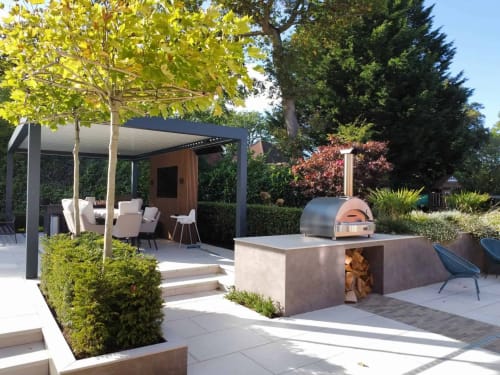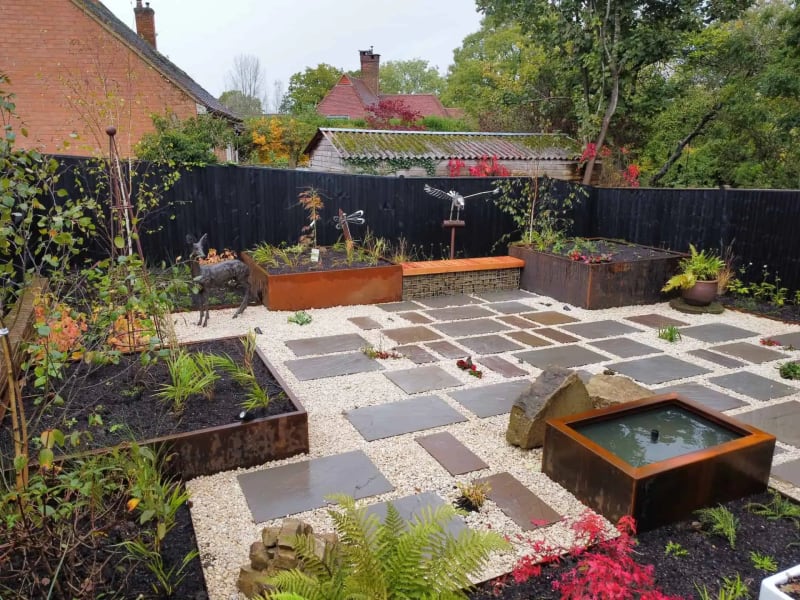
Guildford is fifteen minutes from our base in Woking. It's not a town we visit occasionally — we've worked in gardens across it for years. From the steep plots around Pewley Down to the Garden City streets of Onslow Village, from the newer estates toward Merrow and Burpham to the listed properties in the older parts of town. It's varied, and that variety matters when you're designing and building a garden that has to work for the specific conditions it's sitting in.
The short distance means we know Guildford's gardens in practice, not just in principle. We know the soil types you're likely to encounter in different parts of town, the planning constraints that affect certain areas, and the particular challenges that come with the terrain. That working knowledge saves time and avoids mistakes.
The geology under Guildford
Guildford sits in a natural gap through the North Downs — the River Wey cutting through the chalk ridge that runs east-west across Surrey. That geographical position means the ground beneath the town is more varied than most people expect.
On the chalk of the Downs themselves — the higher ground south of the town around Pewley Down, the slopes near the Cathedral, the ridge above Onslow Village — you get well-draining, alkaline soil. Free-draining is good for certain plants (most Mediterranean species, lavender, many herbs) and means waterlogging isn't typically the primary concern. But chalk holds moisture and nutrients poorly, dries out fast in summer, and the alkaline pH closes off certain species entirely. Rhododendrons, camellias, and most heathers won't thrive here without significant soil modification. Planting schemes need to work with the chemistry rather than fight it.
Drop into the valley around the town centre and the lower areas extending north, and the picture changes. Here you encounter the greensand and Gault clay layers that underlie much of the lower town. Clay means slower drainage, higher moisture retention in winter, and — most importantly for construction — the expansion and contraction that comes with seasonal moisture change. A patio or wall foundation designed for sandy or chalk ground doesn't work on clay. Getting the sub-base specification right, and getting drainage right before anything goes on top, is the starting point for any solid construction on Guildford's clay areas.
Many Guildford gardens sit on mixed soils that have been disturbed by decades of building, landscaping, and garden modification. We always assess each site rather than assuming based on location alone. But arriving with the right geological picture means we're asking the right questions from the start.
Terrain and what it means for design
Parts of Guildford are among the steepest residential land in Surrey. Properties around Pewley Down, the Cathedral area, and Onslow Village can have significant falls — sometimes across a relatively modest garden footprint. A garden that drops sharply away from the house, or climbs steeply from the road, needs a fundamentally different approach to a level plot.
On steeply sloping sites, the design question is usually about creating usable flat areas within the fall. Retaining walls and terracing are the primary tools. Done well, they give a sloping garden structure, drama, and a sequence of spaces that can be more interesting than a flat alternative. Done poorly — walls that haven't accounted for the soil pressure behind them, terraces that aren't properly drained — they're expensive to fix and can cause structural problems over time.
We've built retaining walls and terraced gardens across Guildford and the wider Surrey Hills area. The engineering matters as much as the aesthetics. A wall needs to be calculated for what's behind it, not just designed to look right. Drainage on sloping sites is equally critical — water moving through or under a terrace needs somewhere to go, or it will find its own route, usually through the wall.
Where the slope is gentler, we often work with the fall rather than engineering it away. A garden that descends gradually can use level changes as a design feature — creating definition between zones, producing natural focal points, and giving the space a sense of depth that a flat garden has to work harder to achieve.
Planning in Guildford
Guildford has conservation areas, and they affect what's permissible in garden projects — particularly anything visible from the street or adjacent to listed structures. The character of older residential areas is something the planning authority takes seriously, and materials, boundary treatments, and garden buildings can all fall within scope.
We flag planning considerations at the design stage. If a project is likely to require permission under Permitted Development or a formal planning application, it's better to know before committing to a design than to discover constraints during the build. For conservation areas, we approach materials and design with an additional eye on character — making sure what's proposed fits the setting, not just the garden.
Guildford's housing and what each type brings
Onslow Village was developed in the 1920s as a planned Garden City neighbourhood, and that Arts & Crafts-influenced character shapes the gardens there: generous plots, often with established trees and period boundary walls, designed with more thought for the wider streetscape than most suburban development of any era. These gardens are frequently about sensitive stewardship — rethinking a space that has matured over a century without losing what makes it worth having. Mature trees here are common, some protected, and we assess them early and coordinate with Guildford Borough Council's arboricultural team where TPOs are involved.
Victorian terraces closer to the town centre have smaller, sometimes narrow rear gardens. These respond well to strong design thinking. The challenge is creating a space that feels generous and purposeful without having particularly generous proportions — good zoning, quality materials, and thoughtful planting can do a great deal with a modest footprint.
The newer housing on the outskirts toward Merrow and Burpham tends to produce gardens that are simple in character but often overlooked. These properties frequently have usable outdoor space that a modest investment in design and construction can substantially improve. Starting from a relatively blank canvas has its own advantages.
The Contemporary Remembrance Garden we completed in Guildford demonstrates a different type of commission — a space designed not for entertaining or everyday family use, but to carry meaning and provide a place for reflection. Garden design encompasses a wider range of human needs than landscaping marketing tends to acknowledge. Not every garden project is about outdoor living or property value.
What we offer in Guildford
Garden planning and design starts with a site visit. At fifteen minutes from our base, Guildford is easy to get to and easy to revisit during the design process. We work through how you use the space, what you need from it, and what the site's conditions allow. The design process is collaborative — we bring the practical knowledge, you bring the understanding of how you live.
Garden landscaping takes the design into the ground. Patios, paths, retaining walls, terracing, planting, turfing, drainage, lighting — everything that turns a plan into a finished garden. Our team is local, material deliveries are straightforward, and the short distance from our base means project management stays responsive throughout the build.
Garden aftercare and maintenance is the longer relationship. Lawn care, border maintenance, hedge trimming, seasonal care — the ongoing attention that keeps a garden working well after the build is finished. For gardens we've designed and built, we know the planting scheme, the drainage setup, and the maintenance requirements in detail. There's no handoff between different companies, no knowledge lost between stages.
Working with Guildford's specific conditions
Slope and drainage are the defining concerns across much of Guildford. Even where the slope is modest, poorly managed water on clay or compacted subsoil creates problems. We design drainage solutions at the construction stage — land drains, soakaways, permeable surfaces — rather than discovering the need for them later.
Established trees across Guildford's older areas often require early assessment. We work around them, design with them in mind, and coordinate with the local authority where TPOs apply. The right approach is usually to treat a significant mature tree as a fixed point in the design — a feature to work with, not an obstacle to remove.
Chalk soil management on the higher ground south of the town requires attention to pH and moisture retention. Soil improvement and planting selection that suits alkaline conditions are part of getting a garden on chalk ground to establish well. Importing a standard planting scheme without accounting for the chemistry is a reliable path to disappointment.
Conservation area sensitivity in parts of Guildford means material choices and design approaches that fit the character of the setting. This isn't a constraint that makes good design impossible — it's a framework that often produces more considered results.
A local team for a local area
Guildford is one of the areas where the practical advantages of a local landscaper show up clearly. Site visits that can be arranged on short notice. Build decisions that can be addressed without half a day's travel. Maintenance that's genuinely convenient to schedule. Follow-up conversations that happen at the property rather than over the phone.
We've been working in Guildford consistently for long enough to have an accurate picture of what its gardens require. If you're thinking about a project — new design, a renovation, or ongoing care for a garden that needs more attention than it's been getting — we'd welcome a conversation.