Weybridge is twenty minutes from our Woking base, and it's one of the more distinctive areas we work in across Surrey. The combination of the River Wey and the Thames, the concentration of larger properties, and the particular soil conditions that come with river proximity all add up to a set of garden challenges that rewards knowing the area.
We've designed, built, and maintained gardens across Weybridge for long enough to have a clear picture of what those challenges are and how to approach them. The drainage question comes up on almost every project. The tree question comes up on many. And the expectations — reflecting a market where gardens are a significant component of property value — are consistently high.
Water, soil, and Weybridge's foundations
Weybridge sits at the confluence of the River Wey and the Thames. That geographical fact has direct consequences for gardening and landscaping across much of the town.
The river corridors and the areas adjacent to them sit in flood risk zones. Not every Weybridge garden is affected, but proximity to the rivers means water tables are higher across a wide area than you'd find further inland. In practice, this means soil drainage across much of Weybridge is naturally poor — not because the soil texture is necessarily wrong, but because there's simply less vertical distance for water to travel before it hits the water table. During a wet winter, ground in Weybridge will saturate faster and stay saturated longer than the same soil type in a drier location.
The soil itself tends toward clay in many parts of Weybridge and the wider Elmbridge area — heavy, moisture-retentive, and slow-draining by nature. Clay soil has a place in the garden (it holds nutrients well, doesn't dry out as fast in summer) but it demands respect in the construction phase. Foundations for patios, walls, and steps need to account for clay's tendency to expand when wet and contract when dry. A sub-base that doesn't account for that movement will show it within a few years.
On riverside and low-lying areas, the combination of high water tables and clay means that drainage infrastructure isn't optional — it's the foundation of anything built above it. We design land drainage systems, soakaways, and surface water management as part of the construction process, not as an afterthought. Getting this right at the start is significantly less expensive than addressing it once a terrace has moved or a lawn has become permanently waterlogged.
The scale and character of Weybridge gardens
Weybridge sits within Elmbridge — one of the most affluent boroughs in Surrey, and consistently among the most expensive residential areas in the country outside London. Larger properties predominate, and gardens are a significant part of what makes those properties what they are.
The prestige properties on St George's Hill — a substantial private estate — are a distinct category. Significant grounds, mature plantings, established trees of significant age and, often, significant protection. Garden projects on St George's Hill tend to be about working within an existing framework of high value: redesigning a garden that was made 30 or 40 years ago, incorporating new materials and updated planting while respecting what's already there. Many of the trees have Tree Preservation Orders. Some are older than the houses.
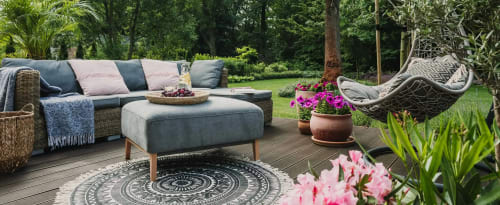
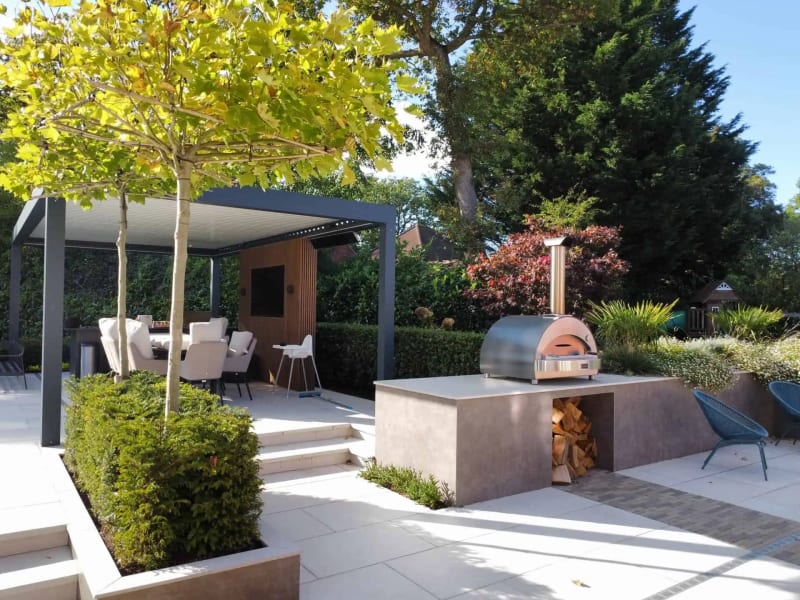
Away from the estate properties, the areas around Oatlands, Brooklands, and the town centre have a more varied stock — smaller plots, some recent development, a wider range of garden situations. The expectations in terms of quality remain high. Gardens in Weybridge function as outdoor rooms in a way that's genuinely integrated with how the houses are used.
The riverside and Thames-side properties bring their own particular character: spectacular settings, often, but also the most demanding drainage conditions and the most significant flood risk considerations. Design here has to account for seasonal inundation on some sites — what's on the ground during a wet winter is a material question, not just an aesthetic one.
Managing mature trees in Weybridge
Weybridge's older properties have had time to accumulate trees. Oak, beech, and other native species planted in the Victorian and Edwardian periods are now of significant size, and many are protected. On the private estates, planting from the mid-twentieth century is itself now mature.
Working around established trees requires an early assessment at the design stage. Root zones need to be accounted for in the positioning of structures — a patio that compromises the root system of a protected oak isn't a viable design, whatever it looks like on paper. We assess trees before designing around them, not after.
Where a client wants to change the character of a garden that has been defined by large trees, the options typically involve working with the light conditions those trees create rather than fighting them. Heavy shade from mature canopy calls for different planting choices, different ground covering approaches, and a design logic that accepts the dominant feature rather than pretending it isn't there.
For trees with TPOs — which are common in Weybridge — we coordinate with Elmbridge Borough Council's tree officers when work is required. Pruning, crown reduction, and any construction within root protection areas needs to be carried out with the appropriate permissions and to the appropriate standards.
What we offer in Weybridge
Garden planning and design starts with understanding the site. In Weybridge, that means an early conversation about drainage, tree constraints, and how the garden is used. The design needs to work with the site's actual conditions — ambitious planting schemes on poorly drained ground don't establish well, and structural elements that don't account for clay movement don't last.
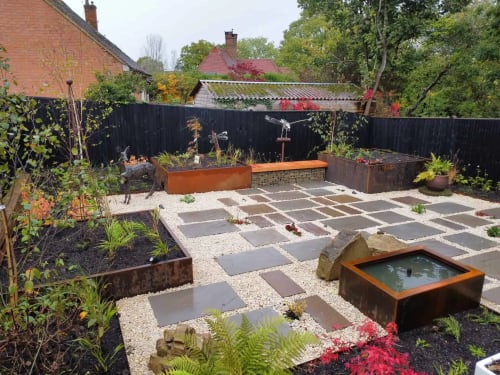
Garden landscaping in Weybridge typically involves more drainage infrastructure than projects in drier parts of Surrey. Land drains, soakaways, channel drainage, permeable surfaces — whichever combination suits the site — are often part of the foundation before any visible landscaping begins. The standard of construction above that foundation is what you see; the drainage work is why it lasts.
Garden aftercare and maintenance is particularly valuable in Weybridge's garden context. Large gardens with mature planting require consistent, knowledgeable management. Tree and shrub maintenance, lawn care across often substantial areas, seasonal planting, and the kind of ongoing attention that keeps an established garden in good condition. For gardens we've also designed and built, we come to the maintenance relationship with detailed knowledge of the scheme.
The range of garden projects in Weybridge
The diversity of property types across Weybridge means the range of garden projects we work on here is wider than in some other parts of Surrey.
At one end, the large estate properties and riverside houses involve substantial redesign projects — often starting with a garden that was last significantly invested in twenty or thirty years ago, now overgrown, outdated in style, and no longer suited to how the household actually uses outdoor space. These projects are typically multi-phase: design and design development, construction, and then a maintenance relationship that begins at practical completion and continues as the planting establishes. The scale alone means these are long projects. The drainage complexity on riverside sites means the groundworks phase is substantial. The maturity of existing planting means the design process involves as much careful removal and preservation as new addition.
At the other end, the terraced and semi-detached properties toward Brooklands and the town centre have gardens where a more contained project — new patio, replanting, boundary treatment, lawn renovation — produces significant results. These aren't complex projects, but they benefit from the same understanding of local soil conditions and drainage requirements. Getting the foundation right matters regardless of scale: clay ground doesn't distinguish between projects by their size.
The consistent thread across Weybridge projects is the drainage question. Clay soil and a high water table are conditions that affect what's buildable, what needs to be accounted for, and what will last. We approach every Weybridge project with that in mind from the first site assessment.
A town where gardens matter
One of the things that distinguishes Weybridge as a market is how seriously gardens are taken as part of property value and daily life. A well-maintained, well-designed garden in this area is a genuine asset — it affects how a house is valued and how the people who live in it use their home.
That doesn't mean every project is large-scale or high-budget. There's good work to be done at every scale in Weybridge. But it does mean that the appetite for quality — for materials that last, for design that's been thought through, for ongoing maintenance that keeps the garden in good condition — is higher than in many parts of Surrey.
We've worked in Weybridge extensively enough to understand the local expectations and, more importantly, the local conditions. Drainage, tree management, and construction quality aren't abstract concerns here — they're the practical foundation of garden projects that hold up over time.
Woking to Weybridge is twenty minutes. If your garden isn't working as well as your house deserves, we'd be glad to take a look.